If you haven’t heard the bad news about gluten – it’s only a matter of time. What you don’t know about this protein found in wheat, barley, rye oats and spelt may be hurting you.
A growing body of research now shows that most Americans are genetically predisposed to develop an autoimmune reaction when they eat gluten. Furthermore, many of these people have no obvious symptoms, or any number of non-specific symptoms. Yet their chances of developing colon cancer, pancreatic cancer, lymphoma, arthritis, Crohn’s disease, diabetes, thyroid disease, lupus, Sjogren’s, neurological disorders, and other serious diseases, increase significantly with each passing year that they continue to be exposed to gluten.
Gluten may be the reason some people actually report feeling better on low carb diets – even though these diets are dangerously unhealthy.
One of the main organs affected by gluten is the brain. Many doctors are reporting improvement in patients with schizophrenia, bipolar disorder, epilepsy, autism, ADD and even depression when they go 100% gluten (and dairy) free. Improvement may be apparent after a week, but it can take several months to a year.
Get off Gluten! Open this book and learn how.
JoAnn Farb is a microbiologist,
educator, author and mother.
(Gluten Free -- Casein Free) Plus information to change your life, inspire you, and recipes that are gluten free AND healthy.
Showing posts with label Z Additional Info. Show all posts
Showing posts with label Z Additional Info. Show all posts
Why GF Alone Isn't Enough
By now, you probably realize that being diagnosed with Celiac Disease or gluten sensitivity, means that you are at increased risk for a variety of other diseases. You probably also know that by strictly adhering to a gluten-free diet, you can somewhat mitigate this additional disease risk. But what if by simply eliminating a few more foods, you could significantly reduce your risk of many types of cancer, diabetes, osteoporosis and a variety of autoimmune diseases? What if this new way of eating had a side effect of also reducing your risk of cardiovascular disease? (which is what 50% of Americans die from -- and it's not always a sudden death -- sometimes it is preceded by years of suffering and gradually increasing disability.) What if the new diet also gave you more energy and made it easier to maintain a healthy weight? What if it also reduced your carbon footprint? (In fact just eliminating a few more problematic foods will reduce your contribution to greenhouse gasses more then trading in an SUV for hybrid, AND also requires drastically less water for production.)
While there are many different studies about nutrition that seem to contradict each other, there is one study that stands out head and shoulder's above the rest. It is the longest, largest, most comprehensive study ever, looking at diet and lifestyle factors and linking them with diseases. It is called the Cornell-Oxford-Beijing-CHINA STUDY. The primary author of this study, is professor T Colin Campbell, and he has written a superb book, about his work that also provides a fascinating glimpse into the politics of food and nutrition policy. If you really want a good framework for understanding nutrition, and for protecting your own health, then you must read his book, The China Study. The bottom line from Campbell's work: There is one food that study after study shows increases the risk of many types of cancer, heart disease, osteoporosis, and kidney disease, and that one food is Animal Protein -- in all of it's many forms. Milk protein, fish protein, beef protein, egg protein, chicken protein. In terms of how these can turn on cancer, increase inflammation, stress the kidneys, and cause our bodies to lose calcium, all animal protein is problematic.
The good news however is that you can learn to live without meat and dairy and eggs just as easily as you can learn to live without gluten, and my book, Get Off Gluten, will show you how.
Keep in mind that studies have shown that it is just as challenging to make major dietary changes as it is to make minor ones -- so you might as well make one huge diet overhaul right up front. Eliminate all the health-destroying foods at once, take a few weeks to learn the new ways of preparing food, and after you surmount the learning curve it really does get easy. Best of all, you will get dramatically more benefits than if you only do the minimum, and eliminate gluten.
While there are many different studies about nutrition that seem to contradict each other, there is one study that stands out head and shoulder's above the rest. It is the longest, largest, most comprehensive study ever, looking at diet and lifestyle factors and linking them with diseases. It is called the Cornell-Oxford-Beijing-CHINA STUDY. The primary author of this study, is professor T Colin Campbell, and he has written a superb book, about his work that also provides a fascinating glimpse into the politics of food and nutrition policy. If you really want a good framework for understanding nutrition, and for protecting your own health, then you must read his book, The China Study. The bottom line from Campbell's work: There is one food that study after study shows increases the risk of many types of cancer, heart disease, osteoporosis, and kidney disease, and that one food is Animal Protein -- in all of it's many forms. Milk protein, fish protein, beef protein, egg protein, chicken protein. In terms of how these can turn on cancer, increase inflammation, stress the kidneys, and cause our bodies to lose calcium, all animal protein is problematic.
The good news however is that you can learn to live without meat and dairy and eggs just as easily as you can learn to live without gluten, and my book, Get Off Gluten, will show you how.
Keep in mind that studies have shown that it is just as challenging to make major dietary changes as it is to make minor ones -- so you might as well make one huge diet overhaul right up front. Eliminate all the health-destroying foods at once, take a few weeks to learn the new ways of preparing food, and after you surmount the learning curve it really does get easy. Best of all, you will get dramatically more benefits than if you only do the minimum, and eliminate gluten.
Why Get Off Gluten?
Long before our family went gluten free, we knew our youngest had some sort of GI issues. Looking back, I now think she probably was reacting to gluten (initially via my diet and her nursing) from the day she was born. Of course with exclusive breast feeding and lots of holding/comforting her obvious discomfort was kept to a minimum and her frequent crying could be managed. (Boy how I wish I knew then about gluten and how I could have simply avoided it myself to keep her from getting it.) By the time she was verbal, she was reporting tummy aches many times each week -- but they were never severe enough to slow her down, and our family doctor kept assuring me that tummy aches are very common in little ones and usually related to how they are handling emotional issues.
It wasn't until they got much worse (when she was about 8) that I started to seriously doubt my doctor's reassurances. By then I thought I might be noticing a correlation between bread-eating and her pain. What threw me off the track however, was the fact, that even when we completely avoided wheat, she still had them, but they usually weren't as bad.
I was completely clueless about gluten, and had no idea that she was also still being exposed to gluten when I made things with rye, barley, or oats. Failing to see clear improvement from a wheat-free diet, we went back and forth on letting her have it. I remember my mother's reaction too when I told her my daughter might have a problem with wheat. She said something about hoping it wasn't Celiac Disease, and although I didn't really know what that was, the way my mother said it made me feel like it must be a diagnosis like leprosy, so I made a mental note that whatever it was, that would not be what we were dealing with.
Then a friend tried to explain to me about gluten and what it was and what all it might be in, I clearly remember telling her, "Oh forget that -- we are NOT going there!" I was absolutely certain at that time that by force of will (keeping our heads in the sand) we could avoid exposing ourselves to something as disruptive as eliminating gluten from our daughter's diet.
Of course you can guess the rest of this story, eventually we had to come to terms with reality, and now that we have, it's really not hard at all -- especially since after becoming more educated on this topic, our whole family went gluten-free, and with our kitchen being entirely GF, food prep is as simple as it ever was.
So what was it that persuaded us all to go gluten free? Upon doing more research, we learned for example that most people carry the gene that allows them, (for reasons not well understood at the present time) to become gluten sensitive as a result of environmental triggers (also not well understood -- but viruses, pregnancy, stress are some of the suspected triggers). We also learned that once one's body starts having an immunological reaction to gluten, it appears to be for life -- if and when they are exposed to gluten. (And trust me I looked long and hard in the medical journals trying to find some research that suggested otherwise -- that perhaps given time it would go away, or with certain nutrients, homeopathy acupuncture or treatment, but never was able to find this!)
Then I discovered even more damning things about gluten. Like the fact that as long as the immune system is reacting to gluten (and this may be happening in many people without them even having any obvious symptoms) they are at increased risk for all sorts of cancers, and autoimmune diseases, even the development of allergies later in life.
Most recently there has been a flurry of reports linking gluten consumption with a variety of mental/emotional difficulties and illnesses. Autism, ADD, Depression, Schizophrenia, Bipolar Disorder -- many people with these are reporting a lessening of symptoms when they get off gluten. (And some doctors are concurring with this too.)
I thought that I had no symptoms of gluten intolerance. I initially went gluten-free mainly to support my daughter and to model for her that going GF was not that hard. I had been GF for over a year, when I stumbled upon some study that said that people who went GF showed improvement in psychological well being a year later when pre and post tested.
I remember thinking at that time, "Where was my benefit?!" I was not feeling any improvement in my well being. But then I stopped and reflected. During this same period, we had moved homes twice, went through the sickness, loss and grieving of two members of our extended family, had another family crisis, and our daughter was attacked by a dog. Given that I have struggled with mild depression many times in my life, the fact that I made it through this period without feeling "the cloud" hanging over my head, and actually functioning quite well, I realized THAT was my benefit.
Not too long ago I decided to test all this, I wondered if now, after being GF for close to two years, what would happen if I ate some gluten. Would I notice anything obvious? While I was out-of-town at a fun event I ate a sandwich on whole wheat bread, that contained one of those gluten-based faux meats. About one hour later, this profound cloud descended upon me. I suddenly felt like I was extremely sleep deprived, and my thinking wasn't as clear. It lasted for about 24 hours before it gradually lifted.
It wasn't until they got much worse (when she was about 8) that I started to seriously doubt my doctor's reassurances. By then I thought I might be noticing a correlation between bread-eating and her pain. What threw me off the track however, was the fact, that even when we completely avoided wheat, she still had them, but they usually weren't as bad.
I was completely clueless about gluten, and had no idea that she was also still being exposed to gluten when I made things with rye, barley, or oats. Failing to see clear improvement from a wheat-free diet, we went back and forth on letting her have it. I remember my mother's reaction too when I told her my daughter might have a problem with wheat. She said something about hoping it wasn't Celiac Disease, and although I didn't really know what that was, the way my mother said it made me feel like it must be a diagnosis like leprosy, so I made a mental note that whatever it was, that would not be what we were dealing with.
Then a friend tried to explain to me about gluten and what it was and what all it might be in, I clearly remember telling her, "Oh forget that -- we are NOT going there!" I was absolutely certain at that time that by force of will (keeping our heads in the sand) we could avoid exposing ourselves to something as disruptive as eliminating gluten from our daughter's diet.
Of course you can guess the rest of this story, eventually we had to come to terms with reality, and now that we have, it's really not hard at all -- especially since after becoming more educated on this topic, our whole family went gluten-free, and with our kitchen being entirely GF, food prep is as simple as it ever was.
So what was it that persuaded us all to go gluten free? Upon doing more research, we learned for example that most people carry the gene that allows them, (for reasons not well understood at the present time) to become gluten sensitive as a result of environmental triggers (also not well understood -- but viruses, pregnancy, stress are some of the suspected triggers). We also learned that once one's body starts having an immunological reaction to gluten, it appears to be for life -- if and when they are exposed to gluten. (And trust me I looked long and hard in the medical journals trying to find some research that suggested otherwise -- that perhaps given time it would go away, or with certain nutrients, homeopathy acupuncture or treatment, but never was able to find this!)
Then I discovered even more damning things about gluten. Like the fact that as long as the immune system is reacting to gluten (and this may be happening in many people without them even having any obvious symptoms) they are at increased risk for all sorts of cancers, and autoimmune diseases, even the development of allergies later in life.
Most recently there has been a flurry of reports linking gluten consumption with a variety of mental/emotional difficulties and illnesses. Autism, ADD, Depression, Schizophrenia, Bipolar Disorder -- many people with these are reporting a lessening of symptoms when they get off gluten. (And some doctors are concurring with this too.)
I thought that I had no symptoms of gluten intolerance. I initially went gluten-free mainly to support my daughter and to model for her that going GF was not that hard. I had been GF for over a year, when I stumbled upon some study that said that people who went GF showed improvement in psychological well being a year later when pre and post tested.
I remember thinking at that time, "Where was my benefit?!" I was not feeling any improvement in my well being. But then I stopped and reflected. During this same period, we had moved homes twice, went through the sickness, loss and grieving of two members of our extended family, had another family crisis, and our daughter was attacked by a dog. Given that I have struggled with mild depression many times in my life, the fact that I made it through this period without feeling "the cloud" hanging over my head, and actually functioning quite well, I realized THAT was my benefit.
Not too long ago I decided to test all this, I wondered if now, after being GF for close to two years, what would happen if I ate some gluten. Would I notice anything obvious? While I was out-of-town at a fun event I ate a sandwich on whole wheat bread, that contained one of those gluten-based faux meats. About one hour later, this profound cloud descended upon me. I suddenly felt like I was extremely sleep deprived, and my thinking wasn't as clear. It lasted for about 24 hours before it gradually lifted.
Subscribe to:
Posts (Atom)
About 60% of Americans have the genes that predispose them to becoming gluten sensitive.
Recent research (By Dr. Kenneth Fine) suggests that about half of these people have detectable immunological reactions to gluten, and the majority will NEVER meet the classic definition of celiac disease -- even though gluten IS triggering an autoimmune reaction in their body which may affect many organs or tissues other then the small intestine.

Recipe for these GFCF Penguins is in my book!
Information your doctor might not have..........
- Does Cow's Milk, CAUSE type I Diabetes?!
- The China Study
- Celiac and Cognitive Decline
- Arthritis Symptoms -- Reverse with Diet
- Melamine in U.S. Food Too!
- The Truth about Cow's Milk
- Vit D deficiency misdiagnosed as Fibromyalgia/CFS
- Fibromyalgia Improved by Diet
- Animal Protein linked to Lymphoma
- Does Cow's Milk Cause Crohn's Disease?
- Arthritis and Joint Pain
- Neurological Dysfunction without GI symptoms
- Celiac Disease - The Great Mimic
- Gluten Intolerance no longer rare!
- Osteoporosis --biggest cause is NOT lack of calcium
- Subclinical Gluten Intolerance and the Thyroid
- Happiness with Gluten Elimination
- Gluten and Inflamation
- ADHD
- Down Syndrome -- Screen for Celiac Disease
- Is GM gluten a cause of increase in celiac?
- Ideal Ratio Carbs/Protein/Fat
- Celiac Disease May Present as Liver Disorder
- Prevent and Reverse Heart Disease
- Gluten-Brain Connection
- Gene from father is bigger risk
- Recovering from Lupus With Diet
- prostate cancer
- Mad Cow = Alzheimers?
- Can Diet Prevent Colon Cancer?
- This Presumed Alzheimers WAS Madcow
- Type I Diabetes Linked With Cow's Milk Consumption
- Breastfeeding Delays Gluten Symptoms
- Timing of introduction of gluten to infants
- Brain Functioning and Diet
- Dr Kenneth Fine's New View on Gluten Sensitivity
- Schizophrenia and Celiac
- Eating fish may increase breast cancer risk
- Sorbitol/Polysorbate may be problematic for some...
- Fantastic list of gluten/GF foods
- Prevent Fibroids with Diet
Are You Educated on Genetic Engineering?
Biotechnology is the new frontier. Yet, few people in our country right now, have any idea, just how dramatically Genetic Engineering is poised to change our lives. Proponents believe biotech holds the possibility of doing some great things, and I believe it might have some great applications, but there is also evidence that this technology if misapplied or allowed out of the lab/hospital setting, could have significant and even disasterous consequences for our health, and well being. The problem is, there is so much money to be made right now in biotech, and so little required in terms of safety testing, and no requirement for product labeling, that human hubris and capitalism being what they are, I think we are headed for some difficult lessons -- before appropriate safeguards are put in place. I believe at the very least, people should have the option of taking the risk of exposure or avoiding this risk if they so choose. (But that is currently NOT the case.) Please watch the video below (it is less then 20 minutes long) of how one mother (who just happened to be a wall street food analyst) woke up to this issue. Then go explore this site: Seeds of Deception to learn the facts so that you can protect yourself and your family.
Should you avoid Genetically Engineered Foods?
Check this out -- Vitamin D
Many of us probably have suboptimal levels of vitamin D, which can be a contributing factor to the development of many of the related conditions and symptoms more common in those who are gluten sensitive. Watch this video -- It's worth the investment of thirty minutes of your time. I should mention however, that while some authorities consider D3 superior to D2, there is good data that if D2 is taken in reasonable amounts (like 1000-2000 iu daily -- not the huge megadoses that some doctors recommend taking on a weekly basis) that D2 is very effective. (And for someone like me who prefers to minimize any possible exposure to prions which may contaminate animal derrived substances -- of which D3 is one -- this is very good news.)
Dietition Jack Norris has great info on Vitamin D here. Be sure also to read Vitamin D Researcher/MD Michael Hollick's book, The UV Advantage.
Dietition Jack Norris has great info on Vitamin D here. Be sure also to read Vitamin D Researcher/MD Michael Hollick's book, The UV Advantage.
Recurrent Abdominal Pain (R.A.P.)
Pre Celiac Disease?
As soon as my daughter could talk she began to report to me that her tummy almost always hurt. Although it didn't become really bad until she was about 8 years old -- this I believe was due to long term exclusive breastfeeding. Throughout her early years, I raised the issue of her chronic abdominal pain with our family doctor on many occaisions, and he would assure me that nothing was wrong, that RAP was very common in children and usually due to emotional issues. When it increased in severity we went to see another doctor -- he thought she might have ulcers -- but that test came back negative and the other tests he ran showed that she was in good health. He thought she was fine too. Eventually I learned about gluten from a friend and well you can read the rest of this story by clicking on the links to articles at the top of this page. However the main point I wish to make here is this: In looking back, it is clear to me now that my daughter -- probably from birth was reacting to gluten. Her fussiness, her greenish stools, her starting to nurse and then pulling off and crying, and then years of tummy aches -- all suggest that gluten was causing her issues from the very beginning. On many occaisions I suspected that wheat might be affecting her -- but its withdrawal never entirely resolved her issues. Now of course I know that gluten is not just in wheat, but also barley, spelt, rye, oats and lots of things made from these. RAP is very common and most the time, it's cause is never found. I would urge anyone who's child is suffering, to explore the possibility that gluten might be the cause of their distress.
As soon as my daughter could talk she began to report to me that her tummy almost always hurt. Although it didn't become really bad until she was about 8 years old -- this I believe was due to long term exclusive breastfeeding. Throughout her early years, I raised the issue of her chronic abdominal pain with our family doctor on many occaisions, and he would assure me that nothing was wrong, that RAP was very common in children and usually due to emotional issues. When it increased in severity we went to see another doctor -- he thought she might have ulcers -- but that test came back negative and the other tests he ran showed that she was in good health. He thought she was fine too. Eventually I learned about gluten from a friend and well you can read the rest of this story by clicking on the links to articles at the top of this page. However the main point I wish to make here is this: In looking back, it is clear to me now that my daughter -- probably from birth was reacting to gluten. Her fussiness, her greenish stools, her starting to nurse and then pulling off and crying, and then years of tummy aches -- all suggest that gluten was causing her issues from the very beginning. On many occaisions I suspected that wheat might be affecting her -- but its withdrawal never entirely resolved her issues. Now of course I know that gluten is not just in wheat, but also barley, spelt, rye, oats and lots of things made from these. RAP is very common and most the time, it's cause is never found. I would urge anyone who's child is suffering, to explore the possibility that gluten might be the cause of their distress.
Why is Gluten so Problematic?
August of 2009 Scientific American published this very in-depth article on Celiac Disease:
http://www.scientificamerican.com/article.cfm?id=celiac-disease-insights
With this quote in it:
"Gluten, however, has a peculiar structure: it is unusually rich in the amino acids glutamine and proline. This property renders part of the molecule impervious to our protein-chopping machinery, leaving small protein fragments, or peptides, intact."
However one thing the article left unanswered. I want to know what is the scientific basis for so many doctors believing that antigliadin antibodies are non-specific and are not (by themselves) indicitive of a problem? The article said that anti-gliadin antibodies are NOT considered specific to celiac disease because they are often found in people who do not have celiac disease. But given that it has only been about 65 years that the medical profession has even made the connection between celiac disease and gluten, and only SIX years since the medical profession realized the incidence was at least TEN TIMES more common then they previously thought....why are they still assuming that anti-gliadin antibodies are nonspecific?
Could it be that all those people who do have antigliadin antibodies in their systems, but don't show damage to the villi are still having a dangerous reaction to gluten? Should the definition of celiac disease be altered...or else dropped altogether and simply be part of a condition called gluten sensitivity which may or may not create visible damage to the villi of the small intestine?
http://www.scientificamerican.com/article.cfm?id=celiac-disease-insights
With this quote in it:
"Gluten, however, has a peculiar structure: it is unusually rich in the amino acids glutamine and proline. This property renders part of the molecule impervious to our protein-chopping machinery, leaving small protein fragments, or peptides, intact."
However one thing the article left unanswered. I want to know what is the scientific basis for so many doctors believing that antigliadin antibodies are non-specific and are not (by themselves) indicitive of a problem? The article said that anti-gliadin antibodies are NOT considered specific to celiac disease because they are often found in people who do not have celiac disease. But given that it has only been about 65 years that the medical profession has even made the connection between celiac disease and gluten, and only SIX years since the medical profession realized the incidence was at least TEN TIMES more common then they previously thought....why are they still assuming that anti-gliadin antibodies are nonspecific?
Could it be that all those people who do have antigliadin antibodies in their systems, but don't show damage to the villi are still having a dangerous reaction to gluten? Should the definition of celiac disease be altered...or else dropped altogether and simply be part of a condition called gluten sensitivity which may or may not create visible damage to the villi of the small intestine?
Taxonomic Relationship Amongst Grains
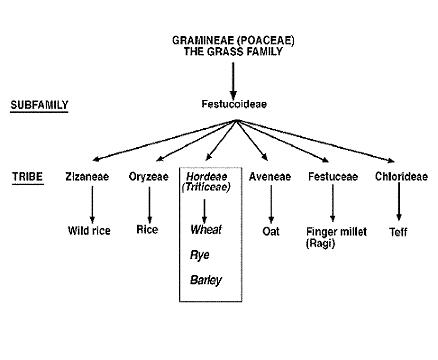
Only the Hordeae tribe make their own gluten -- but oats can absorb gluten if they are grown or stored near gluten containing grains.
.
.
.